Social Catfish Review 2026: Pricing, Features
Trying Social Catfish usually starts with a pretty normal internet-age problem. You are talking to someone online, a few things feel off, and now that tiny bit of doubt is doing laps in your head. Maybe the photos look a little too polished. Maybe the phone number does not match the story. Maybe the username shows up in places you did not expect. That is the kind of situation Social Catfish is built for.
What makes it appealing right away is how it lets you start with scraps instead of a full identity. You can search with a photo, email, phone number, username, name, or address, which feels much closer to real life than the old-school people search model. Most of the time, nobody hands you a complete profile and says, “Here, verify me.”
At the same time, this is one of those products where the first impression and the payment reality are not exactly the same experience. It feels approachable at the start. Then the paid layers show up, and the mood changes a bit.
Social Catfish Quick Verdict
| Field | Verdict |
| Overall Rating | 7.8/10 |
| Best For | Verifying online identities, checking suspicious profiles, reverse lookups from limited clues |
| Ease of Use | Easy to start, especially for image, phone, email, and username searches |
| Data Depth | Broad search coverage, though source transparency is thinner than some users will want |
| Biggest Strength | Multiple search entry points fit how people actually investigate online identities |
| Biggest Weakness | Trial-to-subscription flow and premium upsells can feel more expensive than expected |
Why You Can Trust This Review
This review is based on a close, hands-on evaluation of the tool’s features, pricing, and real-world performance across different types of searches. It reflects a practical understanding of how people search tools work, including their strengths, limitations, and common data gaps. The insights are presented with a focus on accuracy, transparency, and responsible use of information—avoiding hype or unsupported claims. The goal is to give you a reliable, experience-backed perspective so you can make a well-informed decision.
Social Catfish Overview
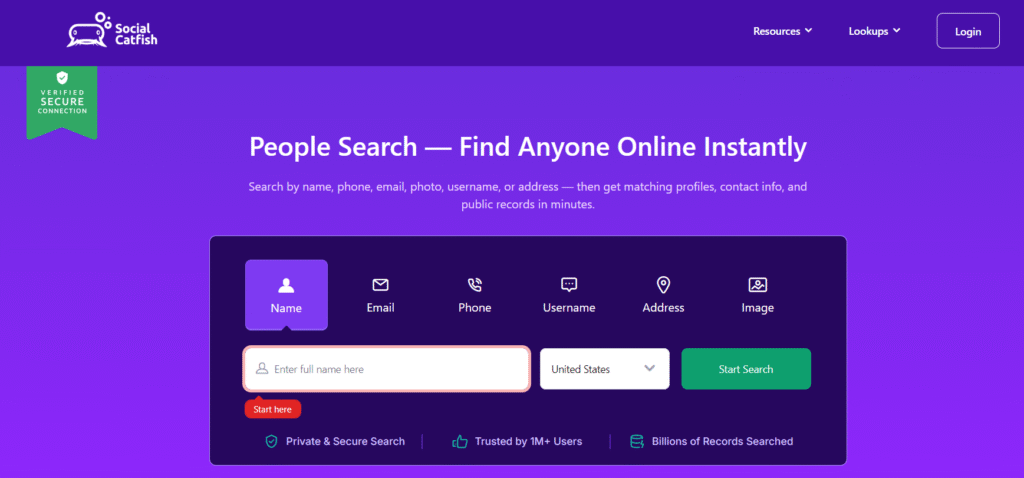
Social Catfish is a people search website focused on identity checks and reverse lookups. Its pitch is simple: help users verify whether someone is real, avoid scams, find lost connections, and investigate online identities using whatever clue they already have. That clue could be a photo, email address, phone number, username, name, or physical address.
That search-first design is what gives it an edge. A lot of people search sites still feel built for users who already know exactly who they are looking for. Social Catfish feels more tuned for the messy version of reality, where all you have is a profile picture and a bad feeling.
It also stretches beyond routine searches into one-time investigation packages like ID verification and crypto or financial investigations. That broader menu gives it more range, but it also makes the whole experience feel less casual once you move past the starter search plans.
Social Catfish Features
- Reverse Image Search: This is one of the strongest parts of the experience because it matches how online suspicion usually starts: with a photo that feels recycled, too polished, or strangely familiar across profiles.
- Email Lookup: Email search is practical when all you have is a contact address from a dating app, message thread, or sign-up trail and want to see whether it connects to a wider digital footprint.
- Phone Number Lookup: This comes in handy for unknown callers, odd texting patterns, and situations where someone shares a number that deserves a second look before the conversation goes any further.
- Username Lookup: One of the more underrated options here, since so many online interactions begin with handles rather than real names. It is a useful way to spot account reuse or identity mismatches.
- People Search and Name Search: For users who do have a name to work with, this gives a more traditional lookup route and rounds out the reverse-search-heavy setup with something more familiar.
- Search History: Not glamorous, but genuinely helpful. When comparing multiple searches or revisiting a case later, having a record of past lookups saves time and cuts down on repeat work.
- Document Checks and Consultation Calls: These are the lesser-known extras tied to higher-end packages, and they make the site feel closer to a guided investigation option than a simple do-it-yourself search page.
Our Testing Methodology
- The review was built around the way Social Catfish is actually positioned: as an identity-check and reverse-search option, not just a generic directory for looking people up.
- The feature analysis stayed tightly tied to verifiable items only. That meant focusing on image, email, phone, username, address, and people search functions, along with the higher-tier extras listed with premium packages.
- Special attention went to how someone would realistically use it. Most people do not arrive with a full legal identity and neat supporting documents. They arrive with a photo, a number, a handle, and some suspicion.
- The pricing side got extra scrutiny because this is where people search websites often become slippery. Trial language, subscription billing, and investigation upsells can change the whole experience quickly.
- Ease of use was judged by how fast a new user could understand where to begin. In that respect, Social Catfish does a good job. The main search paths are intuitive, and the entry points make sense.
- Data quality was approached more cautiously. Big record-count claims sound impressive, but database size alone does not guarantee strong matches, fresh results, or clean identity links.
- The final judgment also considered softer friction points, including the jump from simple search product to premium investigation pitch. That shift is not subtle, and some users will feel it immediately.
Hands-On Experience
Social Catfish feels built for uncertainty, which is probably the right way to put it. It works best when you do not have a complete picture and need to start somewhere. That makes it more practical than many traditional lookup sites, especially for online dating, social media, and random-message situations.
The best part is how natural the search options feel. If you have a photo, there is an obvious place to go. Same with a phone number, email, or username. There is very little friction in figuring out your next step, and that matters because most people landing here are already a little uneasy.
The small annoyance comes later. The first impression is “okay, I can check this quickly.” Then the pricing layers kick in, and it starts to feel like you opened a simple search site and wandered into a private-investigator brochure. Not always a dealbreaker, but it does shift the vibe. A bit of sticker shock is not out of the question.
Social Catfish Results & Data Quality
Social Catfish works best as a verification aid, not a truth machine. That is the healthiest way to frame it. Its strongest advantage is the number of ways you can begin a search, which makes it well suited to real online situations where the clues are incomplete and slightly messy.
It also leans on large-scale claims around public records and social profile coverage. Those claims can sound reassuring, but they only tell part of the story. A giant database is nice in theory. In practice, users care more about whether the result is relevant, recent, and tied to the right person.
That is where expectations need to stay grounded. Social Catfish looks helpful for connecting dots, spotting inconsistencies, and pressure-testing somebody’s story. What it does not fully answer upfront is how consistently accurate or current those matches are across every search type. So the value is real, but it is more “helpful signal” than “final verdict from the heavens.”
Social Catfish Pricing & Paywall Reality
This is where Social Catfish gets a little more complicated. The trial pricing looks approachable, but the recurring plans and premium investigation offers can add up fast. It is not outrageously priced for the category, but it is also not the sort of thing most casual users will shrug off.
| Plan | Price | Features |
| Social Search Trial | $5.73 for 3 days | Trial access for social search |
| Image Search Trial | $6.87 for 3 days | Trial access for image search |
| 1 Month | $36 | Standard monthly search membership |
| 3 Month | $23.66/mo billed as $71 | Lower monthly rate with multi-month billing |
| 12 Month | 20% off with annual billing (Social Search Pro) | Annual plan discount |
Social Catfish Speed & Usability
On the usability side, Social Catfish is easy to grasp. The search types are laid out in a way that matches real behavior, and that removes a lot of the guesswork. You do not need a long walkthrough just to get started.
The web-based setup also keeps things simple. No app install, no extra fuss. That part is refreshingly straightforward.
Where things get slightly bumpier is around plan selection and paid paths. Searching feels simple. Choosing how much to spend feels less simple. It is not a confusing interface problem so much as a “wait, which version of this am I actually buying?” problem.
Social Catfish Data Sources & Reliability
Social Catfish presents itself as a reverse-search site pulling from public records, social profiles, and identity-linked online traces. That mix makes sense for the audience it is chasing. People do not always need a formal records-heavy lookup. Often they just want to know whether a person’s story holds together.
The issue is not that the source mix sounds weak. It is that the transparency around match quality and freshness feels thinner than ideal. Record volume and profile coverage are easy to market. Accuracy in messy real-world cases is harder to summarize, and that is the part users actually care about.
So the most realistic way to use it is as a cross-checking layer. It can help surface patterns, overlaps, and red flags. It should not be treated as the final word on someone’s identity without additional verification.
Privacy & Ethical Use
Anything in this category deserves a little caution. Social Catfish can be genuinely helpful for scam prevention, identity checks, and protecting yourself before sharing money or personal data. Used that way, it makes sense.
The line gets crossed when curiosity turns into obsession or when search results are treated like permission to harass somebody. That is where people get weird, fast.
The better mindset is defensive, not intrusive. Use it to verify, compare, and sanity-check. Do not use it as an excuse to build a conspiracy board over one suspicious selfie and a weird username. Internet sleuthing has a way of getting dramatic when it should probably just stay practical.
Social Catfish Pros & Cons
| Pros | Cons |
| Multiple reverse-search options match real online investigation habits | Large database claims do not automatically equal better match quality |
| Reverse image, email, phone, and username search are easy entry points | Source transparency is not especially deep from the buyer’s perspective |
| Good fit for scam checks and identity verification | Casual users might only need one check, not an ongoing membership |
| Search history adds continuity for repeated checks | |
| Higher-end services include consultation calls and document checks | |
| Web access keeps setup simple |
Who Should Use It
- People trying to verify someone from a dating app, social media account, or messaging platform
- Users dealing with suspicious photos, phone numbers, emails, or usernames
- Anyone who wants more than a name-based lookup and prefers several ways to start a search
- People comfortable paying for deeper investigation help if a situation feels serious
- Users who understand that reverse lookups are best for cross-checking and red-flag spotting
- Anyone who wants a more modern identity-check approach than an old-fashioned people directory
Final Verdict
Social Catfish gets a lot right where it counts most. It meets users at the messy starting point, which is usually a photo, a number, a username, or a vague sense that something is not adding up. That alone makes it feel more practical than many older people search options.
The downside is the money side of the experience. The trial entry looks manageable, but the recurring plans and premium investigation packages can make the whole thing feel heavier than expected. It is not cheap, and it is definitely not something to treat like a casual curiosity click.
Still, for identity checks and scam screening, it has a stronger real-world use case than many competitors. Go in with grounded expectations, use it as a verification layer rather than a final answer, and it can be genuinely helpful. Just do not expect the price path to be gentle.
FAQs
What is Social Catfish mainly for?
It is mainly built for identity verification and reverse lookups. People use it to check whether someone online appears real by searching with a photo, phone number, email, username, name, or address.
Does Social Catfish offer reverse image search?
Yes. Reverse image search is one of its main draws and one of the more practical parts of the experience, especially for checking suspicious profile photos or possible impersonation.
Can Social Catfish search using a phone number or email?
Yes. It supports both phone and email lookup, which is useful when those are the only clues available from a conversation, text thread, or online profile.
How much does Social Catfish cost?
It offers a $5.73 three-day Social Search trial, a $6.87 three-day Image Search trial, a $36 monthly plan, and a three-month option at $23.66 per month billed as $71.
Does Social Catfish have a free trial?
What it offers instead is short paid trial access for specific search types, so it is a low-cost entry point rather than a true free trial.
Is Social Catfish good for scam detection?
It is well suited for scam checks because it supports reverse searches using the kinds of clues scam targets often have, like profile images, phone numbers, email addresses, and usernames.
Who is Social Catfish best suited for?
It is best for people who want to verify online identities and are comfortable paying for reverse search access. It makes the most sense when you have incomplete clues and need to cross-check somebody’s story.